How to Get a Coin Collection Appraised
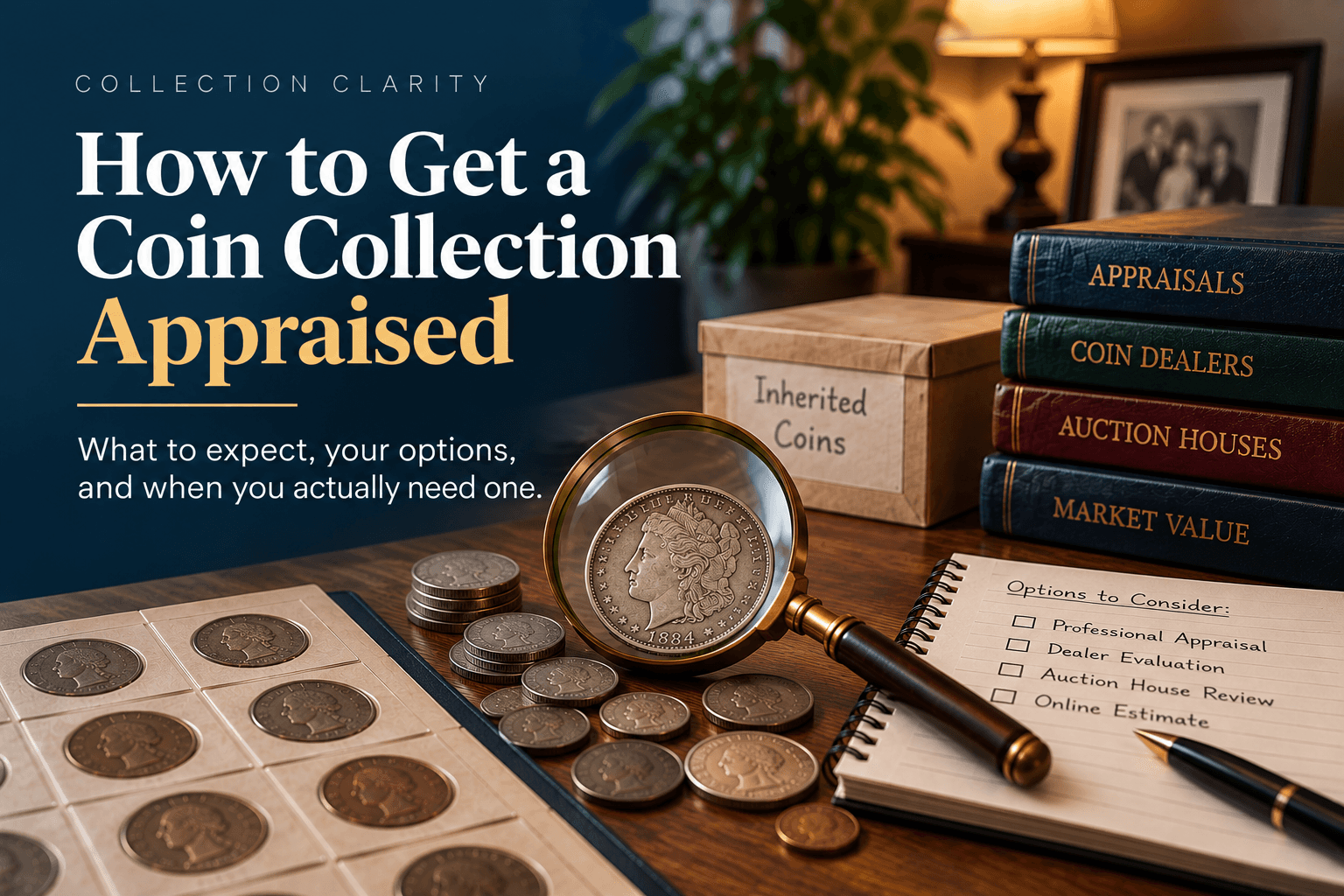
If you inherited a coin collection, getting it appraised may seem like the obvious first step.
But before you start calling coin dealers or paying for a professional appraisal, it helps to understand what “appraisal” actually means. Depending on what you need, you may not need a formal appraisal at all.
For many inherited collections, the first question is simpler:
What do I have, roughly what is it worth, and which parts of the collection deserve more attention?
Answering those questions first can help you decide whether you need a professional appraisal, a dealer evaluation, an auction-house review—or simply a better understanding of the collection before deciding what to do next.
First, Decide Why You Need the Collection Appraised
Not every coin collection needs the same type of valuation.
If you simply inherited a collection and want to understand what you have before deciding whether to keep or sell it, a collection-level estimate may be enough to get started.
Other situations may require something more formal.
For example, you may need a professional appraisal for an estate, insurance coverage, charitable donation, tax matter, or another legal or financial purpose. Those situations can have specific documentation and valuation requirements, so an informal estimate should not be treated as a substitute.
If your goal is eventually to sell, however, you are usually trying to answer a different question:
What might this collection realistically sell for in the current market?
That distinction matters. If you're still trying to understand the value itself, start with our guide to how much an inherited coin collection is worth.
Understand the Different Ways a Coin Collection Can Be Valued
People often use the words appraisal, estimate, and offer interchangeably. They are not necessarily the same thing.
A Professional Appraisal
A professional appraisal is a documented valuation prepared for a specific purpose.
Depending on the circumstances, the appraiser may examine the collection in person, inventory individual pieces, research comparable sales, evaluate condition and prepare written documentation.
This can make sense when you actually need a formal valuation.
But if you have boxes of inherited coins and are simply trying to figure out what to do next, commissioning a detailed appraisal of everything may be more than you need at the beginning.
A Dealer Evaluation
A coin dealer may examine your collection and tell you what appears valuable. Some dealers provide informal evaluations, while others may offer appraisal services.
A dealer may also make an offer to purchase the collection.
That can be useful, but remember that an offer to buy is not the same thing as an independent estimate of market value.
A dealer buying coins has business expenses, resale risk and the need to earn a margin. A purchase offer can therefore be lower than the amount the coins might ultimately sell for to collectors.
That difference does not automatically make the offer unfair. It simply means the numbers answer different questions.
An Auction-House Evaluation
If a collection contains material appropriate for auction, an auction house may review it and estimate what certain coins or groups could bring at auction.
This can be especially relevant for stronger individual coins or collections with meaningful collector demand.
Auction estimates still are not guarantees. Actual results depend on the material, bidders, market conditions, fees and other factors.
An Online Collection Estimate
An online estimate based on photographs occupies a different place in the process.
It cannot provide the same certainty as physically examining a coin, and it should not be treated as authentication, professional grading or a formal appraisal.
What it can do is help answer the initial collection-level questions:
What appears to be here? Where does the value seem concentrated? What deserves closer inspection? And what probably does not require hours of individual research?
That is the role Collection Clarity is designed to fill.
What Actually Determines the Value of a Coin Collection?
The age of a collection alone tells you surprisingly little about its value.
Two collections containing hundreds of old coins can have dramatically different market values.
Important factors can include:
Precious-metal content. Many U.S. coins contain silver or gold, creating an underlying metal value even when the coins have little additional collector premium.
Date and mintmark. Certain dates and mintmarks are much scarcer than others within the same coin series.
Condition. Condition can make an enormous difference for some collectible coins, although precise grading usually requires much better evidence than a few overview photographs.
Certification. Coins authenticated and graded by established grading services may be easier to identify and compare with similar sales.
Mint products and original packaging. Proof sets, Mint sets and other packaged products should be identified by their actual year, product and composition rather than assumed to have a generic value.
Current market evidence. What comparable items have actually sold for is generally more informative than an optimistic asking price.
Collection Clarity's own estimation methodology follows that last principle closely: recent realized sales for comparable material take precedence over catalog values and asking prices when adequate evidence exists, while uncertain upside is flagged rather than automatically added to the estimate.
Don't Start by Researching Every Coin
This is one of the easiest ways to turn an inherited collection into an overwhelming project.
Imagine inheriting 800 coins.
You could spend weeks reading dates, checking mintmarks, searching online and trying to determine grades. Much of that effort may eventually reveal that large portions of the collection consist of relatively common material.
A better first step is usually triage.
Look at the collection as a whole. Preserve its existing organization. Identify broad groups such as albums, silver coins, proof and Mint sets, certified coins, older U.S. coins, foreign coins, currency and loose bulk material.
Then identify the areas where learning more could actually change your decisions.
The objective at this stage isn't to create a perfect catalog.
It's to figure out where to look closer.
If you're earlier in the process, our guide to what to do after inheriting a coin collection walks through the first steps from the beginning.
Be Careful With Online Coin Values
Searching a coin's date on the internet can produce wildly different numbers.
One of the biggest reasons is that an asking price is not necessarily a market value.
Someone can list a coin online for almost any price. That doesn't mean a buyer will pay it.
When researching a collection, actual completed sales of genuinely comparable items are generally more useful. The comparison also needs to be appropriate: the same denomination, date and mintmark where visible, similar condition, the correct Mint product and composition, and comparable certification when relevant.
Even then, photographs may leave important details unresolved.
A conservative estimate should acknowledge that uncertainty rather than assuming the most valuable possibility.
Should You Get Every Coin Professionally Graded?
Usually, grading every coin before understanding the collection is not a sensible first move.
Professional grading costs money, and many coins are worth less than the cost and effort involved in having them graded.
The better question is whether specific coins have enough potential value—and enough uncertainty around authenticity or condition—to justify professional grading.
That decision becomes much easier after you've identified the collection's likely value drivers.
How to Prepare a Collection for an Appraisal
You don't need to reorganize everything before someone evaluates it.
In fact, preserving the collection as you received it can be useful.
Keep coins in existing holders, albums, flips and original Mint packaging when practical. Keep labels, notes, boxes and certificates with the items they accompanied.
Avoid cleaning or polishing coins. And don't unnecessarily open sealed or potentially collectible original packaging simply to see what's inside.
If you're starting with an online evaluation, take broad overview photographs first. Those images help establish the size and composition of the collection. Closer photographs can then be used for items that warrant additional attention.
How Much Does a Coin Collection Appraisal Cost?
There isn't one standard price.
The cost can depend on the size and complexity of the collection, how much individual research is required, whether written documentation is needed, the purpose of the appraisal, and the professional providing it.
Before paying for a formal appraisal, ask exactly what you will receive and whether that level of service is necessary for your situation.
If your immediate goal is simply to understand an inherited collection before making a decision, starting with a collection-level assessment may help determine whether paying for additional professional work is worthwhile.
A Practical Order of Operations
For many inherited collections, the process can be simpler than it initially appears:
Preserve the collection as you received it. Don't clean coins or unnecessarily remove them from holders or packaging.
Understand the collection at a high level. Identify the major groups and approximate composition.
Identify the likely value drivers. Determine which coins, sets or groups deserve closer examination.
Resolve important unknowns. Get better photographs, verify dates or mintmarks, or seek professional authentication where it could materially affect value.
Choose the appropriate next step. That could be a formal appraisal, selective grading, a dealer, an auction house, or another selling route. If selling is your next step, see our guide to how to sell an inherited coin collection before choosing a buyer.
You don't have to become a coin expert before taking that first step.
Start With an Independent Collection-Level Estimate
If you've inherited a coin collection and aren't sure whether you need a professional appraisal yet, Collection Clarity can give you a simpler place to start.
Submit photographs of the collection and we'll review the material as a whole, identify the areas that appear to matter most, and provide a conservative estimate based on the evidence available.
The goal isn't to replace professional grading, authentication or a formal appraisal.
It's to help you understand what you have before deciding what to do with it.

Ready to Understand
What You Have?
Upload photos of your collection and get a free, independent estimate—so you can understand its potential value before deciding what to do next.
CC
Collection Clarity
Clear, independent guidance for inherited coin collections.